Conversion, Baptism, and Communion: A Biblical Exegesis
An examination of the order of salvation, the nature of believer's baptism, and the proper sequence of the ordinances in the life of the Christian.
Introduction
A question that arises with some frequency among new and growing believers concerns the relationship between three foundational Christian realities: conversion, baptism, and communion. Specifically, many sincere believers feel that they must first resolve personal failures or "make things right" before they are worthy to be baptized — and that they must be baptized before they may partake of the Lord's Supper. This document addresses both of those questions in turn, drawing from the theology of Scripture and the witness of the New Testament church.
Part I: Justification, Sanctification, and the Ground of Worthiness
The Two Gifts Given at Salvation
When a person genuinely repents and trusts in Jesus Christ for salvation, God bestows two inseparable but distinct gifts simultaneously: justification and sanctification.
Justification is the forensic, legal act by which God declares the believing sinner righteous — not on the basis of their own merit, but solely on the basis of Christ's atoning work on the cross. This declaration is permanent, complete, and not subject to revision based on subsequent behavior. Paul states it clearly:
_"but God shows his love for us in that while we were still sinners, Christ died for us."* — Romans 5:8
Justification does not wait for self-improvement. It is applied to the sinner in their brokenness. The promise of 1 John 1:9 extends the same certainty:
"If we confess our sins, he is faithful and just to forgive us our sins and to cleanse us from all unrighteousness."
The forgiveness described here is not conditional on future performance — it is described as already accomplished for the one who has confessed and believed.
Sanctification, by contrast, is the ongoing, progressive work of God in the believer's life by which He conforms them increasingly to the image of Christ. It is not a prerequisite for salvation or baptism; it is the fruit of both. Where justification declares the sinner clean once and for all, sanctification is the daily walk that follows.
The confusion of these two gifts — expecting justification's permanence but treating it as conditioned on sanctification's progress — is one of the most common errors among sincere believers, and it invariably results in delay, self-reliance, and spiritual paralysis.
The Lesson of the Upper Room (John 13)
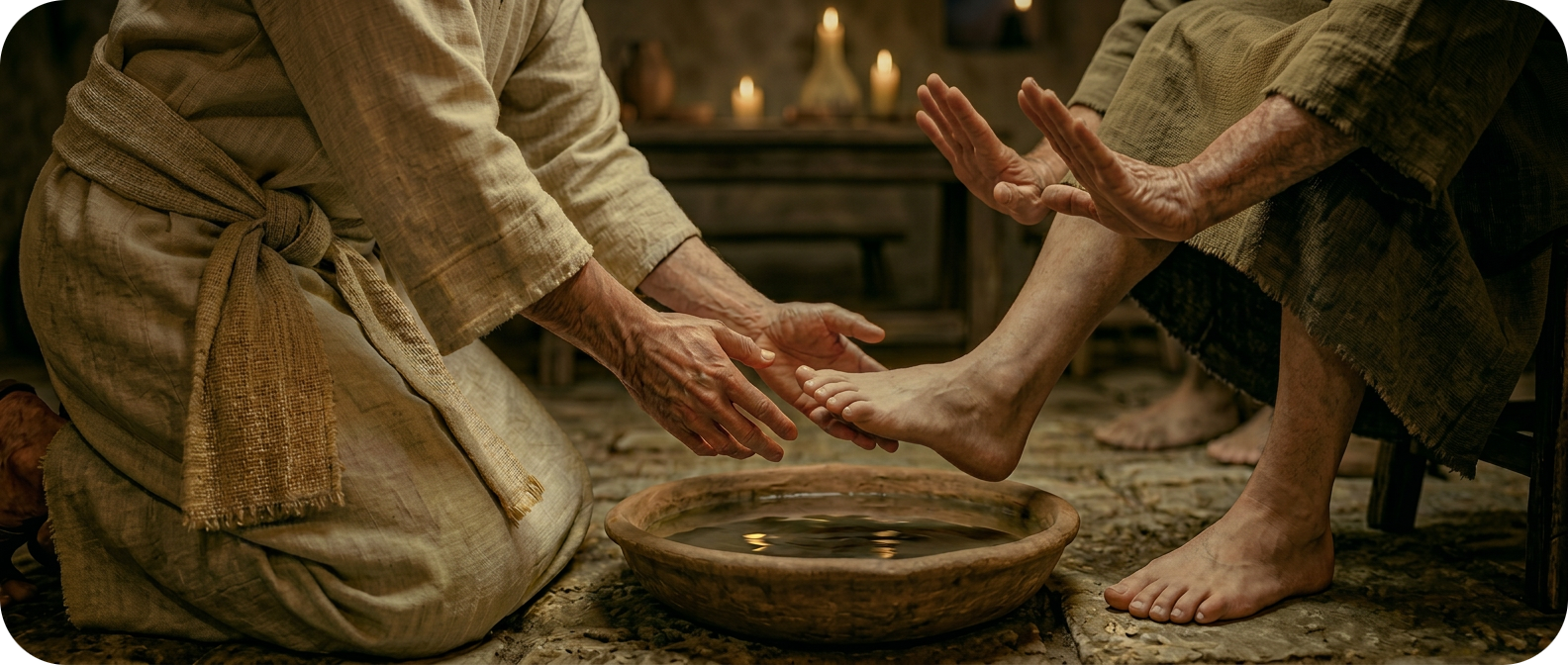
Jesus addressed this very confusion in the upper room. When He came to wash the disciples' feet, Peter refused: "You shall never wash my feet." Jesus responded: "If I do not wash you, you have no share with me." Peter then overcorrected: "Lord, not my feet only but also my hands and my head!"
Jesus answered: "The one who has bathed does not need to wash, except for his feet, but is completely clean. And you are clean." — John 13:8–10
The imagery here is theologically precise. The bath represents justification — the singular, complete cleansing accomplished at salvation. The washing of the feet represents sanctification — the ongoing, daily cleansing required as the believer walks through a fallen world. Jesus' answer addresses both errors in one statement: you do not need another bath (justification is complete), but you do need your feet washed (sanctification is ongoing — and that is My work, not yours).
The believer who delays baptism because they feel they must first "clean themselves up" is, in effect, reversing Peter's second error: rather than asking Jesus to do more cleansing than necessary, they are refusing to come until they have done the cleansing themselves. Jesus' answer to both is the same — you are already clean.
Part II: The Urgent Pursuit of Baptism in the New Testament
A Pattern Without Exception
One of the most striking features of every conversion account in the New Testament is the immediacy of baptism. Without a single exception, the newly converted believer moved directly to baptism without delay. This pattern is not incidental — it is consistent enough to constitute a normative expectation for the early church.
The Ethiopian Eunuch (Acts 8:36–38) Mid-journey, upon understanding and believing the gospel as Philip explained it from Isaiah 53, the eunuch interrupted: "See, here is water! What prevents me from being baptized?" He stopped his chariot and was baptized immediately. He raised no objections about unworthiness, offered no condition of prior self-improvement, and was not counseled to wait.
Saul of Tarsus (Acts 22:16) After three days of blindness, fasting, and prayer — a period of profound spiritual upheaval — Ananias arrived and said: "And now why do you wait? Rise and be baptized and wash away your sins, calling on his name." The exhortation is explicit: don't wait. Even after three days of intense preparation, the message was one of urgency, not further delay.
The Philippian Jailer (Acts 16:33) Following his conversion in the middle of the night, the Philippian jailer was baptized "immediately" — in that same night hour — together with his household.
Pentecost (Acts 2:41) Three thousand people were baptized on the day they first believed and responded to Peter's proclamation.
The New Testament presents no account of a convert who delayed baptism due to felt unworthiness, unresolved sin, or a need to first make personal amends. The absence of such a pattern is itself exegetically significant. The urgency with which every New Testament convert pursued baptism suggests that the proper posture is one of confident faith in what Christ has already accomplished — not prolonged self-examination aimed at making oneself worthy.
What Baptism Is — and Is Not
Believer's baptism is not a declaration that the one being baptized has attained a certain level of spiritual progress or personal righteousness. It is not a reward for demonstrated improvement or a certificate of completed sanctification. Paul's description in Romans 6:3–4 makes its true nature clear:
"Do you not know that all of us who have been baptized into Christ Jesus were baptized into his death? We were buried therefore with him by baptism into death, in order that, just as Christ was raised from the dead by the glory of the Father, we too might walk in newness of life."
Baptism is a public, symbolic declaration of what Christ has done: His death, burial, and resurrection applied by faith to the life of the believer. It announces the burial of the old self and the beginning of new life in Christ. It does not follow a cleaned-up life — it proclaims the new one. The one who waits to be baptized until their life is in order has misunderstood what baptism declares. Baptism does not say, "I have arrived." It says, "Christ has made me new, and I am now walking in that newness publicly and in community."
Part III: The Order of Baptism and Communion
Baptism as Entry into the Body
Scripture presents a clear and consistent sequence: baptism precedes communion. This is not an arbitrary ecclesiastical convention — it is rooted in the theological relationship between baptism and membership in the body of Christ.
Paul writes in 1 Corinthians 12:13:
"For in one Spirit we were all baptized into one body — Jews or Greeks, slaves or free — and all were made to drink of one Spirit."
Baptism is the public, visible act by which a person is identified as a member of Christ's body. The Lord's Supper is the ongoing, communal meal by which members of that body regularly proclaim Christ's death and reaffirm their shared life in Him (1 Corinthians 11:26). To participate in the meal before being baptized into the body is to claim membership in a community one has not yet publicly entered.
The Pattern in Acts
The sequence established at Pentecost is instructive:
_"So those who received his word were baptized… And they devoted themselves to the apostles' teaching and the fellowship, to the breaking of bread and the prayers."* — Acts 2:41–42
Baptism (v. 41) precedes the breaking of bread (v. 42). This ordering is never reversed in the New Testament. There is no example in Acts or the Epistles of an unbaptized person participating in Communion. Paul's discussion of the Lord's Supper in 1 Corinthians 11 addresses baptized believers exclusively.
The Commission's Order
The Great Commission itself establishes the sequence:
_"Go therefore and make disciples of all nations, baptizing them in the name of the Father and of the Son and of the Holy Spirit, teaching them to observe all that I have commanded you."* — Matthew 28:19–20
Baptism precedes the full observance of all Christ's commands — including the ordinance of Communion. This is not incidental sequencing. Baptism is the entry point into the covenant community; Communion is the ongoing sustenance of that community's shared life.
Baptism is the door. Communion is the family table. One is welcomed to the table after entering through the door — not before.
Part IV: The Work of God in and Through the Ordinances
The Things That Need "Making Right" Are Not Barriers — They Are the Journey
A believer who feels the weight of unresolved relationships, ongoing struggles, or areas of known sin should not be encouraged to see these as disqualifications from baptism. Rather, they are the very terrain over which God will work in the believer through their walk in community, the practice of the sacraments, and the ongoing ministry of the Holy Spirit.
Philippians 1:6 does not promise that God will have completed His work before the believer steps forward in faith. It promises that He will complete it:
"And I am sure of this, that he who began a good work in you will bring it to completion at the day of Jesus Christ."
The good work is not completed before baptism — it was begun at conversion and will be carried to completion through the entire course of the believer's life. Baptism is not the end of that work; it is the public beginning of walking in it within the community of faith.
The Role of the Enemy
It is worth noting the spiritual dynamics at play when a genuinely converted believer experiences prolonged delay in baptism due to a sense of unworthiness. Scripture identifies the accuser of the brethren (Revelation 12:10) as one who uses shame, guilt, and a distorted sense of personal inadequacy to prevent believers from stepping into the fullness of what God has for them.
The message "you must first fix yourself before you can come" is not the message of the gospel. The gospel's message is: "Come as you are — Christ has already fixed the decisive thing, and He will continue the work in you." When a believer's heart tells them they are not yet good enough to be baptized, it is worth asking whose voice that is — because it is not the voice of the One who said, "Come to me, all who labor and are heavy laden, and I will give you rest" (Matthew 11:28).
Summary and Conclusion
The following summary captures the biblical teaching on each question addressed in this document:
1. Must a believer be morally improved or have "made things right" before being baptized? No. Baptism follows conversion, not sanctification. Justification is complete at the moment of genuine faith and repentance. The New Testament pattern is one of immediate baptism upon belief, with no instances of delay for the purpose of prior self-improvement.
2. What does baptism declare? Baptism is a public proclamation of what Christ has accomplished: the believer's death to the old self and resurrection to new life in Him (Romans 6:3–4). It declares not who the believer has become but what Christ has done.
3. Must baptism precede communion? Yes. The consistent sequence in the New Testament is belief → baptism → participation in the Lord's Supper. Baptism publicly identifies the believer as a member of the body of Christ; Communion is the ongoing practice of that body. There is no New Testament example of the order reversed.
4. What about the things a believer still needs to "work through"? These are not barriers to baptism — they are the journey of sanctification that God will accomplish in and through the believer as they walk in obedient faith, in community, and in the practice of the ordinances. The believer does not arrive at baptism having completed that journey. They arrive at baptism to begin walking it together with their brothers and sisters in Christ.
The gospel is not an invitation to clean oneself up and then come. It is an invitation to come, and to be made clean — and then to walk together, being made cleaner still, until the day He completes the work He has begun.
This document is intended for general instruction and reflection. All Scripture quotations are from the English Standard Version (ESV) unless otherwise noted.